-
- July 21, 2026
You write "easy aerobic run, 45 minutes" and click save. Your athlete goes out and runs at the top of what feels easy to them. For one athlete that's comfortably in zone 2. For another, "easy" drifts towards zone 3. No one made a mistake. But the session might not be the one you intended.
I see this all the time with coaches. They spend a lot of time on the architecture of a training plan, load, recovery, intensity blocks. Then they describe the workouts in two sentences and ship them. The assumption is that the hard part is the programming. But whether your athlete actually does what you intended is determined by the brief.
I think part of the problem is that coaches don't always realize just how much more they know about training than many of their athletes. "Easy aerobic run" might be enough information for you to execute the session exactly as intended. It might also be enough for an experienced athlete who has spent years learning what different efforts should feel like. But for a less experienced athlete, you're asking them to fill in gaps they might not even know exist.
That doesn't mean every workout needs an essay attached to it. Too much detail can be just as unhelpful if the important instructions get buried. The goal is to give the athlete enough information to remove the decisions you don't want them making for themselves, without overwhelming them with things they don't need to know.
Every session you assign is brittle until an athlete executes it. And athletes make interpretive decisions throughout: what "easy" means on a day they slept badly, whether to cut short when their legs are heavy, how hard "strong effort" is compared to "hard effort." Those decisions happen without you, based entirely on what the athlete understood from what you wrote.
The problem isn't a lack of effort or care. "Easy aerobic run" is an instruction that requires translation, and every athlete translates it differently. Instead, you might write: "Keep this at an RPE of 3 out of 10. It should feel comfortable and controlled, like you could keep going well beyond the end of the run. You should be able to hold a conversation without struggling for breath." Now you've given the athlete several ways to understand what you mean by easy, without burying them in instructions.
This matters beyond execution quality. If you review a session and the athlete says it felt easy but the HR data says otherwise, you're now troubleshooting a training signal you can't fully trust. When the brief anchors the session to something measurable, the data that comes back is cleaner. You can coach off it.
This week: Pick one upcoming session and look at it from the perspective of an athlete who knows far less about training than you do. Add one specific anchor, a heart rate ceiling, a pace range, or a concrete feel cue, before you assign it. Give them enough to execute the session as you intended, without giving them so much that the important parts get lost.
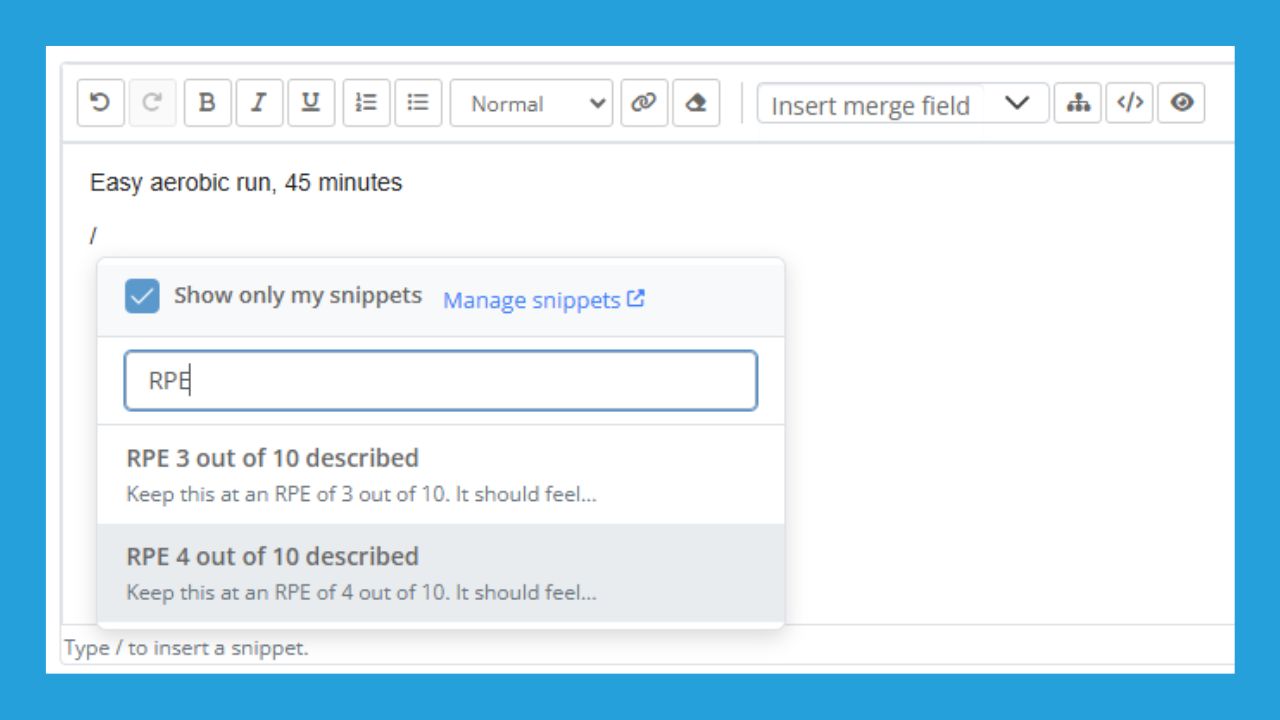
Don't want to do the extra typing? In Training Tilt you can just save workouts into your re-usable library to drag and drop or you can just hit the / and pull text in from your saved content snippets. A tiny bit of extra work to provide a lot more value to your clients.

Cam Langsford
Enthusiastic age group triathlete, software architect and founder of health and fitness community platform "Training Tilt".
Take our Free "Authentic" Marketing Course for Coaches
Designed for endurance sport coaches. Marketing doesn't need to be pushy. The best marketing simply creates a win-win relationship between you and your customers. Take the simple 6 part course to learn more.